
“In The Zone of Interest, viewers are accomplices to evil” won the 2025 Cyrena Pondrom Prize for Literary Inquiry in the Midwest Undergraduate Conference for the Humanities, then known as the Madison Undergraduate Conference for the Humanities. The original essay has been edited for style and grammar.
“Remoteness from reality and such thoughtlessness can wreak more havoc than all the evil instincts taken together which, perhaps, are inherent in man.”
Courtesy of A24
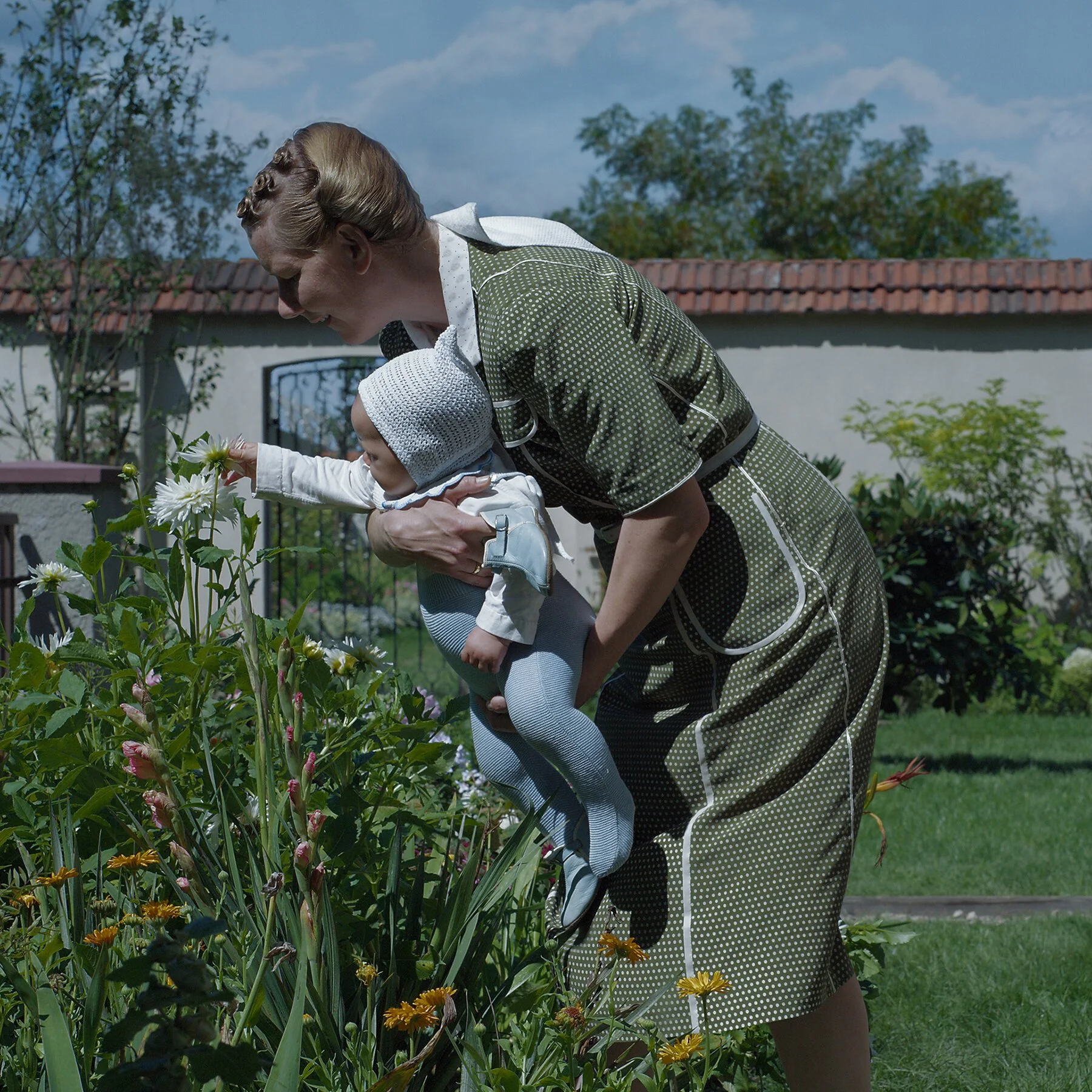
In 1963, the Jewish philosopher and Holocaust survivor Hannah Arendt published a report in The New Yorker titled “Eichmann in Jerusalem: A Report on the Banality of Evil.” Her report analyzed the trial of Nazi official Adolf Eichmann, sentenced to death for his role in planning the “Final Solution,” or the systematic murder of six million Jews. It reached a groundbreaking conclusion: those individuals responsible for orchestrating a genocide of a scale the world claimed never before to have seen, Arendt argued, had the same mental fitness and rationality as any average human today. Sixty years after her report was published, Jewish filmmaker Jonathan Glazer debuted his film The Zone of Interest, which used Arendt’s theory to tell a new story of the real life Auschwitz commandant Rudolf Höss and his family’s day-to-day lives. The film is a domestic tale of a couple raising their children, maintaining a beautiful house, and eventually struggling with the transferral of Höss to another city for his job. But as viewers watch a family drama unfurl amidst the picturesque cinescapes of Poland, we are made all too aware of another story taking place behind the land’s towering gray walls. In The Zone of Interest, Glazer uses strategic shot movement and a harrowing soundscape to make the argument that evil operates within the framework of everyman endeavors and their ordinary motivations. It is humans who make the choice of whether or not the evil will be obfuscated from their view.
In The Zone of Interest, relentlessly harsh sound design made to recreate life in Auschwitz serves as a reminder to viewers of what going-ons the Höss family is deliberately choosing to ignore. Because Glazer made a point to never showcase the atrocities happening beyond the Höss’ idyllic domestic life, sound designer Johnnie Burn was tasked with infusing the unconscionability of Höss’ work into the drudgery of day-to-day family drama and Nazi bureaucracy. Constant angry shouts and tortured screams, gunshots, and blasting crematorium furnaces litter the soundscape while the Höss family casually takes trips to the local lake or hosts backyard birthday parties. While one could argue that background noise alone, unpaired with visual evidence of the suffering it indicates, may cause viewers to mentally separate the story we see from the story we hear, there is a particular scene which forces us to confront the reality which the protagonists do not. When matriarch Hedwig’s mother comes to visit and is taken on a tour of the garden, she is startled by her daughter’s lack of reaction to the screams that have thus gone unmentioned in the film. This acknowledgement is followed by a sequence of static close-ups of vivid flowers in the garden, and an unbearable auditory crescendo of all the sounds which had previously been far, far away. The drone of bees, shouting of S.S. officers, and anguished screams become louder as shots of the flowers transition quicker, until everything reaches a boiling point. An extreme close-up of a red dahlia turns into a blood red screen and a man’s long screams are abruptly cut to silence. This overstimulation is a sharp divergence from the routine background sounds of Holocaust machinery: it is a “split second of humane connection between character and audience … [which provides] evidence that the massacre is real, and evidence that everyone present knows exactly what is happening” (Herzog). In using sound design to represent atrocities absent from the Höss family’s concern or consideration, The Zone of Interest emphasizes how easy it is to fall into the routine of evil and by refusing to address violence when it is enacted against a them who are not us. Until it is shoved in our faces through overemphasized sound, viewers may make a similar choice as the Höss family: tuning out the faraway spectre of death in favor of watching a child giggle in the grass.
While the sound design in The Zone of Interest reminds viewers of the horrific repercussions of Höss’ ordinary evil, it is ultimately the film’s use of unique camera movement—or lack thereof—that communicates why the Auschwitz death camp’s commandant has almost indistinguishable motivations from most working men in hierarchical bureaucracies. Through most of the film, cinematographer Łukasz Żal’s camera remains defiantly still as characters enter in and out of frame for different static shots, focusing much more on landscapes and building interiors than those people who operate within them. For example, in the film’s final sequence, when Höss sets out to leave his upgraded office in Berlin and descends the building’s stairways, he looks from far away into the peephole of a dark corridor. This peephole is part of a door that is opened to the present, as multiple janitors noisily clean interior exhibits in the Auschwitz-Birkenau State Museum. The scene eventually cuts back to Höss’ stare in 1944, after which he silently descends the stairs into darkness. Though characters consistently move throughout camera frame in both scenes, Żal only uses long durations of wide static shots to observe both Höss in his S.S. building and janitorial staff in the Holocaust museum. In them, the characters are diminutive compared to their surroundings; framed by tall, sterile walls and never-ending hallways. Through Żal’s camerawork, Höss is not made formidable through low angles or close-ups. He is relegated to the same position as the nameless workers who maintain the memory of his destruction. Imagery of towering glass walls filled with charred shoes or dingy furnace rooms with containers fit for humans could alert viewers to the grand significance of Höss’ atrocities, but the camera reveals a simple truth: the minutiae of everyday tasks needed to support Nazi operations are not any different to those of the humans cleaning up their mess more than fifty years later. When audience members are forced to stare unflinchingly into the peephole alongside one of history’s most infamous killers, we “see things … from a privileged position, with the eyes of those who [have] the power of life and death,” rather than those who pay their price (Wilson). This cinematographic staticity relates viewers more closely with the banality of Höss’ evil than it does the resistance to it, leaving viewers to interrogate how we will one day be looked upon for what we did to others. As the camera watches Höss turn himself away from the fallout of his life’s success, and descend until he is enveloped by darkness, modern audiences are left to deliberate the lengths we too will go to to justify contributing toward institutionalized violence in pursuit of personal achievement.
The sound design and cinematography of The Zone of Interest are deliberate deviations from typical Holocaust narratives, both in terms of their cutting-edge technological qualities and unique framings of antisemitic violence. Similar to films such as Schindler’s List or The Boy in the Striped Pajamas, the story technically distances itself from the plight of Jews in favor of depicting the elite German perspective. Nevertheless, The Zone of Interest is nothing like most of the Holocaust stories that came before it because of its refusal to validate ideas of engrained monstrosity or sycophancy in its Nazi main characters. Neither Höss nor his family were ever shown to directly maim or derogate a Jewish person, even if that is something the audience can reasonably assume they do. Instead, the camera shows them having heartfelt conversations about achieving their domestic dreams after years of struggle as the sound of gunshot litters the air. It is, ironically, through this humanization of a genocide enabler that Glazer is able to most effectively illustrate the insidious nature of evil; the person responsible for orchestring a mass murder of incomprehensible proportions has worries and motivations recognizable to any modern audience. The movie’s premise—of reckoning with the evil coloring our day-to-day lives—is not a far-off hypothetical. Glazer plunged his message straight into the veins of Hollywood at the Oscars in 2024, where he used his acceptance speech to urge viewers to resist closing their eyes to the genocide of Palestinians in Gaza. Yet the swift and calculated backlash towards his speech from the media and fans of the film, despite near-universal praise for The Zone of Interest when it was first released, once again beckons us to question how adamantly we humans decide to obscure others’ suffering from our gaze. It is easy to condemn the Holocaust in retrospect, or even to acknowledge its ideology’s influence on the present day. But it is difficult to acknowledge the terror within ourselves which has annihilated today’s “other,” sparking Glazer’s call to action. Should we want to take something away from The Zone of Interest, we must first wholeheartedly accept its premise as a character study across time and space. Perhaps then one day, when we peer through history’s keyhole to see the results of our own procedural lives, we will finally be able to accept what may end up staring back at us.
Bibliography
Arendt, Hannah. “Eichmann in Jerusalem.” The New Yorker, 9 Feb. 1963, www.newyorker.com/magazine/1963/02/16/eichmann-in-jerusalem-i.
Herzog, Amy. “Proximities of Violence | Film Quarterly | University of California Press.” University of California Press, 2024, online.ucpress.edu/fq/article/77/3/8/200021/Proximities-of-ViolenceThe-Zone-of-Interest.
Wilson, Kristi. “Film and Genocide.” Project MUSE, University of Wisconsin Press, 2012, muse.jhu.edu/pub/19/monograph/book/18964.