
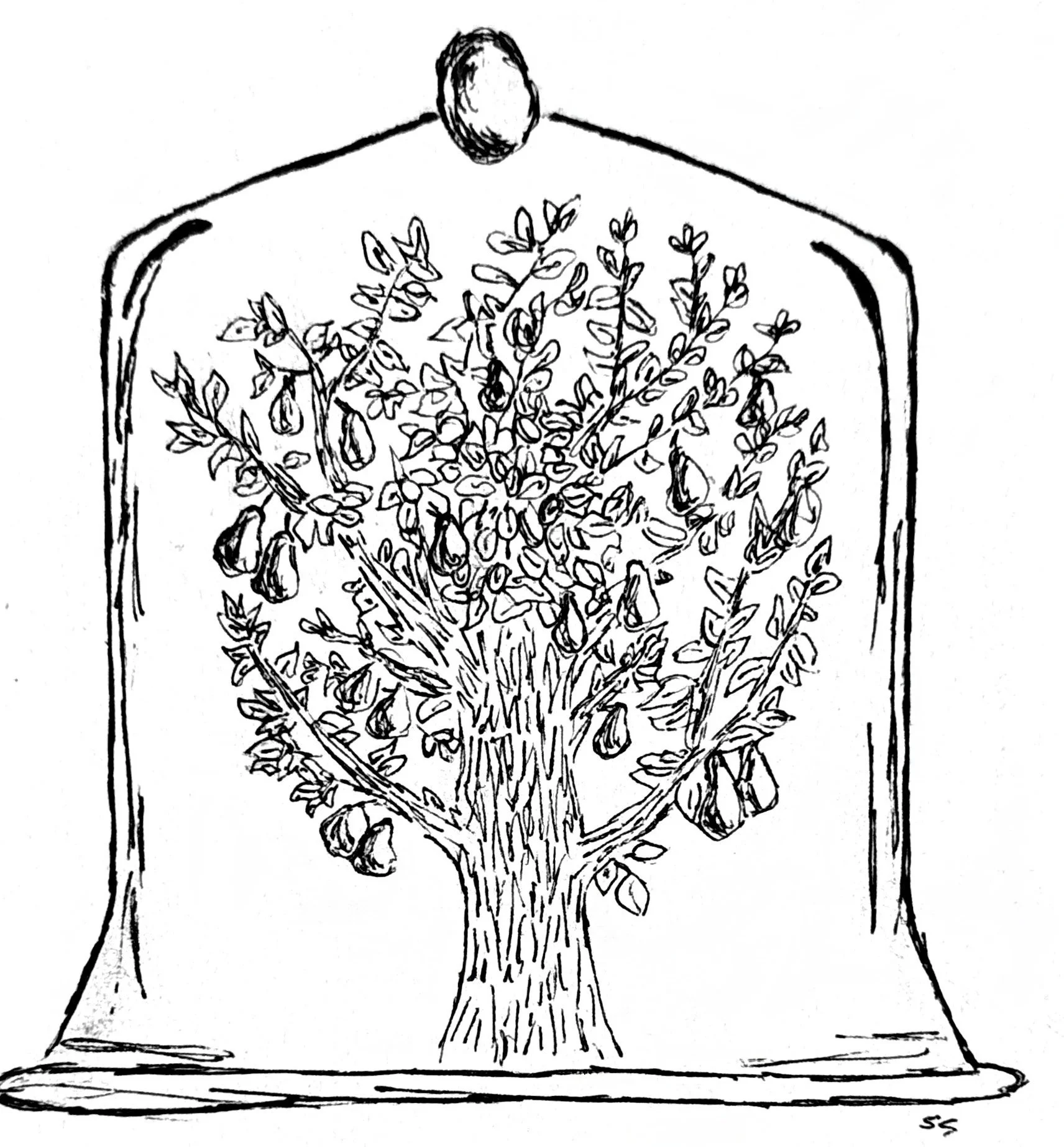
In Sylvia Plath’s The Bell Jar, birth functions as a dual symbol representing both the oppression that confines women, and the possibility of rebirth that Esther Greenwood desperately seeks. Throughout the novel, Esther is overwhelmed by the burden of choice, famously represented as a fig tree whose branching futures threaten to paralyze her with existential indecision. As she contemplates suicide, Esther imagines death as a kind of reverse-birth, a means of returning to a blank state untouched by gender expectations about purity, motherhood, and success. Plath thus introduces the newborn baby as a motif for the freedom Esther seeks: a life without the suffocating pressure of the bell jar. Through scenes that juxtapose birth and death, Plath reveals how Esther’s captivation with birth reflects her fear of socially imposed femininity and a longing for an existence free of gender pressure.
A central symbol in the novel is the bell jar itself. A bell jar is a glass container commonly used in laboratories to isolate objects in a sealed, airless space, suggesting conditions of suffocation and confinement. Esther feels trapped by a narrow set of acceptable futures. Her mother insists that she learn shorthand and become a practical secretary. Buddy Willard, her first boyfriend and an aspiring doctor, dismisses her ambition to become a poet and assumes she will eventually marry him and settle into a conventional domestic role. The broader cultural expectation is that she must choose between intellectual fulfillment and marriage. The bell jar descends over Esther and seals her into a world where every path demands the loss of some essential part of herself, whether that is her creativity, independence, or autonomy. This is why birth becomes such a charged motif. On one hand, it represents the very expectations she fears, motherhood as an inevitable destiny. On the other, it suggests the possibility of starting over, of emerging into a life not yet constrained by those roles.
Esther’s fascination with birth is evident from the beginning of the novel. Several moments—such as taking a hot bath after a night of drinking or waking up from her food-poisoned daze—depict her undergoing a symbolic rebirth. She says, “The longer I lay there in the clear hot water the purer I felt, and when I stepped out at last and wrapped myself in one of the big, soft white hotel bath towels I felt pure and sweet as a new baby” (Plath 20), and later, “I felt purged and holy and ready for a new life” (Plath 48). Newborns universally represent innocence, hope, and possibility. These descriptions suggest Esther’s desire to strip away societal expectations and return to a blank slate. However, her moments of self-purification do not offer lasting change. This gap between temporary purification and genuine transformation reinforces Esther’s sense of entrapment. Though she can mimic the physical sensations of rebirth, she cannot escape the gendered constraints that await her outside the bath or after her purge. Plath uses these early scenes to foreshadow Esther’s growing urge for a permanent rebirth, which ultimately manifests as her fixation on suicide.
Esther wants to live a life defined by her own ambitions, and deeply fears gender limiting her autonomy. Her struggle with oppressive gender roles makes the childbirth scene in chapter six especially significant. She observes a woman giving birth with Buddy Willard and finds the experience disturbing. Doctors treat the woman’s pain as routine, and decisions are made for her rather than by her. This event reinforces Esther’s fear that womanhood is synonymous with submission, sacrifice, and loss of self. While the mother’s experience repels her, Esther watches with a sense of fascination, suggesting a deeper psychological pull beneath her horror. This tension becomes clear in chapter eight when Esther skis for the first time. As she descends the slope, she experiences a moment of clarity. The novel reads, “I thought, ‘This is what it is to be happy.’ I plummeted down past the zigzaggers, the students, the experts, through year after year of doubleness and smiles and compromise, into my own past…the white sweet baby cradled in its mother’s belly” (Plath 97). Here, Esther imagines happiness as a return to the beginning of her existence, before compromise and social performance. The newborn represents a life unburdened by rigid gender roles and social expectations. Esther does not desire motherhood itself, but rather the freedom of an existence not yet constrained by gender expectations. Thus, birth becomes a central paradox in the novel, representing both the fate Esther fears and freedom she desires.
When Esther returns home from New York, the boundary between birth and death becomes increasingly blurred in her mind. She is rejected from a writing program and overwhelmed by her mother’s insistence to learn shorthand and pursue secretarial work. Esther’s mental health deteriorates and she becomes fixated on achieving rebirth through suicide. In chapter thirteen, Esther’s mother makes her volunteer at the local hospital in hopes it will fix her depressive state. Instead, Esther becomes overwhelmed by the demanding mothers in the maternity ward and flees the hospital. The narrative then abruptly shifts to her wandering through the graveyard where her father is buried. By juxtaposing scenes of life and death, Plath mirrors Esther’s fractured mental state and emphasizes how inseparable these concepts have become in her mind.
After Esther’s suicide attempt, Plath uses birth imagery to frame Esther as a symbolic newborn who’s identity must be formed again from an uncertain beginning. At the end of chapter thirteen, Esther swallows a bottle of pills and hides in the crawlspace of her mother’s basement. When she is rescued and awakens in the hospital, Esther demands to see herself in a mirror. At first, she does not recognize her reflection, much like a newborn encountering a mirror for the first time. Plath writes, “It wasn’t a mirror at all, but a picture. You couldn’t tell whether the person in the picture was a man or a woman” (Plath 174). This moment emphasizes the collapse of identity, particularly gender identity, as Esther is not able to recognize herself as a woman. This reflects a newborn-like state of perception, in which gender expectations have not yet been formed or imposed. When she finally recognizes the figure as herself, she drops the mirror, and it shatters. The broken mirror symbolizes the destruction of Esther’s former identity and her inability to piece together a coherent sense of self. Her attempt to die in order to be reborn has not produced immediate healing. Like physical childbirth, Esther’s rebirth is painful and disorienting.
Some may argue that in The Bell Jar, birth functions primarily as a symbol of entrapment, representing the patriarchal roles that confine women to marriage and motherhood. This interpretation is supported by the childbirth scene and Esther’s fear of motherhood. However, viewing birth only as a symbol of oppression overlooks its broader significance in the novel. For Esther, birth also represents the possibility of renewal and escape. While she rejects motherhood, she remains drawn to birth as a metaphor for beginning again without societal expectations. Plath presents birth as confining for the mother, an outcome Esther fears, and liberating for the newborn, a state Esther strives to achieve. This duality is a vital component of Esther’s inner conflict.
For most of The Bell Jar, Esther Greenwood believes that rebirth can only be achieved through annihilation. Plath reframes this belief in the novel’s closing pages when Esther reflects that she has been, “born twice–patched, retreaded and approved for the road” (Plath 244). This statement challenges Esther’s earlier fixation on death as rebirth, suggesting that renewal does not require annihilation, but simply survival. While the bell jar may descend again, Esther’s rebirth is rooted in endurance rather than escape. By concluding the novel with this image, Plath affirms that birth, though entangled with fear, oppression, and death, also offers the possibility of continued existence. Esther does not emerge into a perfect world, but she emerges alive. Her survival is her rebirth.
Works Cited
Plath, Sylvia. The Bell Jar. New York, Harper Perennial, 1971.