
Abstract
Academic surveillance—the practice of monitoring student behaviors by augmenting assignments or using tracking technology—is on the rise in many universities. From Turnitin to blue books, these techniques are often seen as necessary for mitigating a rising tide of student cheating, particularly in the age of large language models (LLMs). A growing body of literature questions this necessity, examining if academic surveillance’s negative effects on students could outweigh its benefits. However, much of this literature remains hypothetical, removed from actual student experiences. This research is the first step in documenting how students actually feel that they and their writing are affected by academic surveillance. College students were surveyed to describe how well several potential impacts of academic surveillance use fit their real-world experiences. Though students described some negative psychological effects—particularly from AI-detectors—the overwhelming majority independently reported a belief that academic surveillance was worthwhile to prevent their peers from cheating with AI.
1 - Introduction
1.1 What is Academic Surveillance?
At its core, academic surveillance is data collection (Williamson, 2019). AI detectors comb through essays for signs of a student’s AI use, blue books let the instructor monitor student test-taking in person, and Honorlock tracks and records a student’s inputs. Each of these forms of academic surveillance involves the collection of student data in order to identify, dissuade, or entirely prevent cheating.
The need for surveilling students’ work is often taken as a given, stemming from the assumption of a widespread “culture of cheating” (Canzonetta & Kannan, 2024, p. 295), with “cheating” referring broadly to any academically dishonest act a student takes to gain an edge over their peers. Responding to this supposed culture, AI and plagiarism detection tools, like Turnitin, frame their surveillance of academic writing not as a neutral tool, but instead as a movement “to dismantle that culture…examine cases where education institutions have changed how young people think and behave—and how these lessons can be applied to promoting integrity” (Canzonetta & Kannan, 2024, p. 295). Cheating is viewed not as a systemic problem stemming from the conditions that students exist in, but instead as a culture based solely in each individual students’ own behaviors and thoughts. Though this outlook may sound harsh, the advent and prevalence of generative AI (specifically large language models) may provide justification. Current trends in cheating behavior mark a genuine cultural shift among students, with upwards of a third of college students admitting to using AI in classes—a trend particularly prevalent in the humanities (Golding et al., 2024). Resulting from this surge of AI use, many instructors see no alternative to academic surveillance: “Teachers do need to know what a student wrote in order to meaningfully assess and respond … even with the best pedagogy, some temptation to take shortcuts with AI will remain when students feel insecure or under pressure. We can’t prevent all such misuse, but we can significantly reduce it by making it more of a hassle” (Mills, 2024). To teachers, academic surveillance is a practical necessity in response to the threat of students using AI.
1.2 Student Responses to Surveillance
Though the reasons favoring surveillance have been discussed extensively, a growing body of literature questions whether these reasons outweigh the potential costs to students’ wellbeing and work. Given the instructor’s presumption of a pervasive culture of cheating, academic surveillance is proposed to cultivate an adversarial relationship between students and instructors—one where students are assumed guilty and must prove their innocence (Fernandes & McIntyre, 2025). The evidence of such a relationship is strengthened by the testimonies of teachers whose “goal is to apprehend and punish” (Zwagerman, 2008, p. 679), who treat surveillance and catching students as the end goal in and of itself, rather than as a means to reduce cheating. Academic surveillance, in this case, is used to identify and punish dishonest behavior, instilling “invigilated obedience, the unsurprising result of ‘replacing the student-teacher relationship with the criminal-police relationship’” (Zwagerman, 2008, p. 683).
Academic surveillance builds an adversarial relationship between teachers and students by instilling a lack of trust. If the student sees the professor as hostile, then even the potential of being thought guilty could incite an atmosphere of anxiety in the classroom. Fears of being falsely thought guilty have precedent, as AI and plagiarism trackers, such as Turnitin, have notoriously high false-positive rates (Gregg-Harrison & Quarterman, 2024). The problem is not solely with surveillance methods being potentially faulty; the mere act of surveillance—a student knowing they are being or will be watched and tracked, regardless of the method—reduces student privacy, and thus has the potential to cause harm. As AI literacy instructor Marc Watkins writes, “If I was a student and a writing instructor saw how I write, with time stamps, keystroke entries, what was copied, what was deleted, and yes, what was made by AI, what would that person think of me? I feel entirely naked just describing how I write—I would be mortified if someone could see that entire process” (Watkins, 2025). The very core of academic surveillance—collecting additional data from students—necessitates threatening the student’s privacy, and thus their feeling of psychological wellbeing and autonomy in the classroom.
To further specify how student wellbeing and autonomy may be affected by academic surveillance, Han et al. (2023) asked students to predict peer responses to a hypothetical surveilled classroom. These predictions were then categorized, giving several expected effects that surveillance in the classroom would have on students. These expected effects include changes to behaviors, such as altering writing to pander to detection software; changes to personal psychology, such as discomfort and anxiety from being monitored; and changes to cognition, such as feeling that their autonomy or identity was harmed. Although this study takes the greatest steps to ground itself in student perspectives, this framework is still fundamentally theoretical—a problem that is widespread in this body of literature.
So far, the threats that academic surveillance may pose to students have been studied theoretically. From instructors’ own anecdotes, to broader theories using teacher perspectives, to even experimental methods with hypothetical students' reactions, the literature remains a step removed from actual student experiences. The current paper takes an initial step in filling this niche, investigating how university students interact with academic surveillance practices as they exist in their classrooms today. Using a mix of qualitative and quantitative survey questions, this paper examines the types of surveillance students encounter, how well expected reactions to surveillance match students experiences, and how justified students believe surveillance is. Though initially hypothesizing that students would share a general sense of psychological harm from surveillance practices, this research actually found that the majority of students viewed academic surveillance as a worthwhile sacrifice to keep their peers honest.
2 - Methods
2.1 Population
Surveys were sent out to undergraduate students at the University of Wisconsin–Madison (n=15) engaged in the Undergraduate Writing Fellows Program as either fellows or tutees. This sampling method yielded a set of responses diverse in both disciplines (including a variety of STEM and humanities majors) and years at the university.
2.2 Survey Setup
Students were surveyed through a mix of both Likert scale and free response questions in order to investigate both quantitative and qualitative trends. The survey started and ended by asking students to self-report how well they thought they understood their professors’ use of surveillance, with the intention of gauging how well students can identify academic surveillance outside of the survey environment.
Following the first of these questions, students were asked to rate and describe the prevalence of academic surveillance on writing assignments across their time in college, as well as to give specific examples of the types of academic surveillance they encountered.
Students then rated how well a series of scenarios matched their experience with academic surveillance. These scenarios reflected the changes in behavior, personal psychology, and cognition predicted in Han et al. (2023), as well as the feeling of an adversarial relationship predicted by Zwagerman (2008). Additionally, students were given scenarios testing potential worry over being falsely accused of cheating and of their data being used, sold, or leaked, issues suggested to be likely by Gregg-Harrison & Quarterman (2024) and Vee (2024), respectively. From here, students then rated and described whether or not they felt the current levels of AI use were justified, along with a complementary question about whether or not they had ever personally decided not to cheat due to academic surveillance. Finally, students briefly identified relevant demographic information, including their year and major.
3 - Results
3.1 Student Knowledge of Academic surveillance.
At the onset of the survey, the majority of students (n=10) reported not feeling knowledgeable about their professor’s use of academic surveillance, with only a small number (n=3) feeling they were somewhat knowledgeable. By the end of the survey, however, students showed an upward trend, with far fewer students feeling not knowledgeable about their professor’s use of academic surveillance (n=3) and far more students tending towards knowledgeable (n=6), as presented in Figure 1.
Figure 1
Changing Knowledge of Professor’s Surveillance Use Before and After Survey
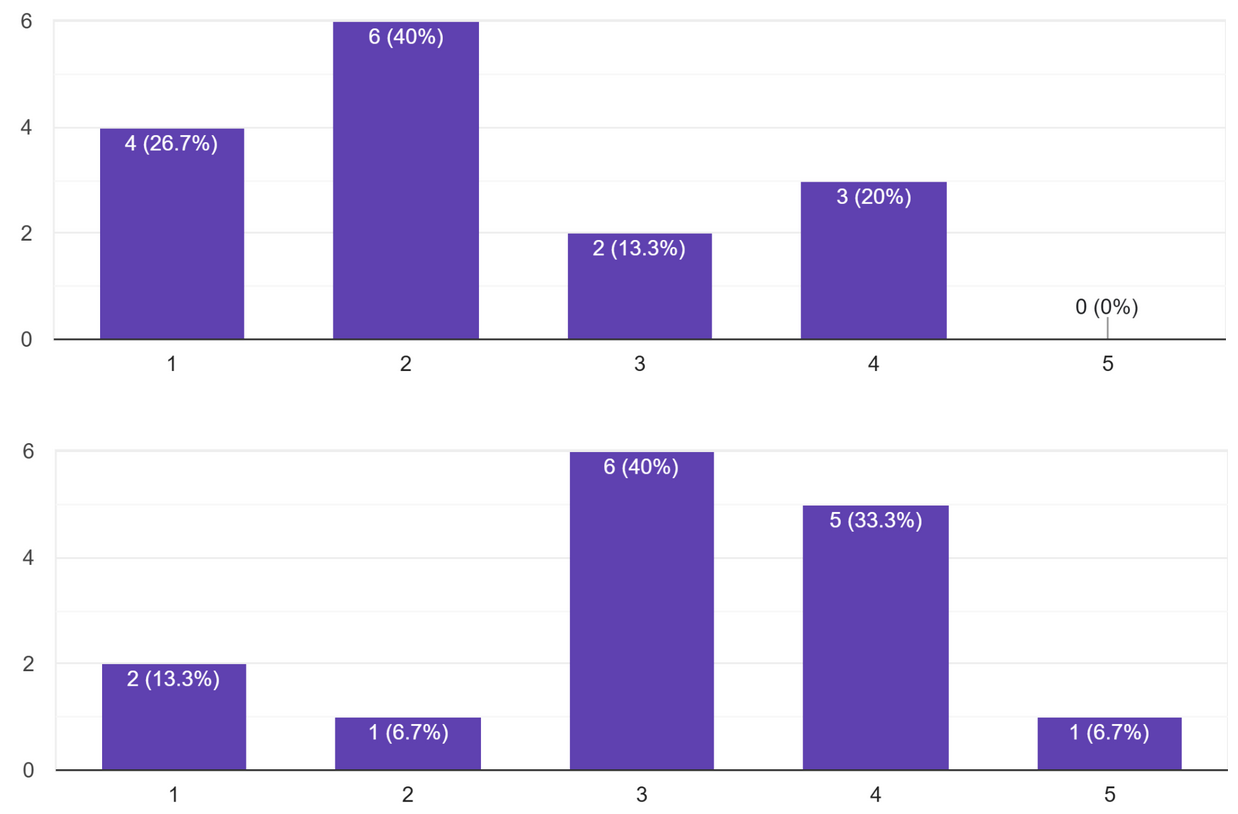
Note. Self-reported student knowledge of their professors’ surveillance use before (top) and after (bottom) taking the survey. Responses ranged from “Not Very Knowledgeable" (1) to “Very Knowledgeable" (5).
The trend of students feeling more knowledgeable about their professors’ use of academic surveillance after the survey may have stemmed from two factors: first, exposure to examples of surveillance they normally wouldn't label as such, and second, prompted reflection about surveillance they’ve encountered. As exposure and prompting by the survey led students to feel more knowledgeable, it is possible that these students do not think about or recognise academic surveillance in their daily lives when not directly prompted. Despite this possibility, the ability for students to describe the types and effects of surveillance they have encountered indicates that the effects are still relevant, even if the students tend not to think about them day-to-day.
3.2 Encountered Surveillance
The majority of students (n=9) felt that the amount of surveillance in classes had increased across their time in college, while only one felt it had decreased (Figure 2). The most common surveillance type students noted increasing was professors switching to in-person, blue book style writing assignments or exams. Technologies used for surveillance were less commonly mentioned, with Turnitin being the most common while tools like Honorlock and checking edit histories were mentioned less frequently.
Figure 2
Student Perspectives On Surveillance Use by Instructors
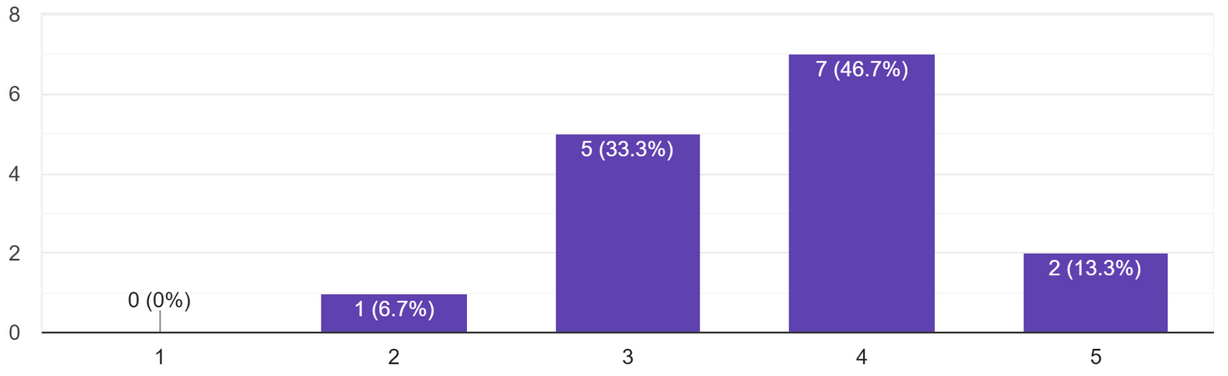
Note. Student self-reports on whether their instructors’ use of surveillance has decreased (1) or increased (5) across their time in college.
When describing these surveillance types, students varied substantially in their tone. Some students described intrusive encounters with surveillance use. “Many of my professors across disciplines have used Turnitin for short writing assignments, which I find frustrating: Turnitin often highlights portions of my work as plagiarized even though they are properly quoted and cited—including the reference list.” Yet, several others described surveillance as rather benign, with one noting, “I don't think anything has been too impactful or prevalent because it is something I am now used to. Tools and strategies like Honorlock and in-person writing is now just a part of academics to counteract the use of AI and cheating in general.”
While most were able to identify at least a few examples of academic surveillance they have encountered, students varied widely in opinion when describing surveillance. The responses illustrated a dichotomy of either frustration, as in “I've used Honorlock for a test once—for an accounting exam. I hated it,” or acceptance, “I’ve taken a few Honorlock exams and exams in person, but these were fairly understandable.” The latter group often described that while, of course, they were not happy to deal with surveillance, they could excuse its use either by virtue of it being so common, or because they felt it was justified.
3.3 Specific Reactions to Academic Surveillance
Though students were split when generally describing academic surveillance as impactful or not, when asked how well the aforementioned predicted reactions fit their experiences, students largely reported not experiencing the predicted behavioral, psychological, and cognitive harms, as displayed in Figure 3.
For behavioral reactions, students resoundingly reported that they did not find workarounds to cheat surveillance systems (n=12), with only one saying they had been pushed to find them. However, several students indicated that this may have been because they would not have cheated in the first place, not because surveillance stopped them. Although a few students (n=3) reported avoiding collaborating with peers for fear of being accused of cheating, the vast majority (n=12) did not.
For psychological reactions, students’ experiences similarly diverged from the expected results. Students overwhelmingly reported not feeling uncomfortable in the classroom (n=12), not feeling pressure from surveillance (n=9), and not having difficulty concentrating due to surveillance (n=11).
For cognitive reactions, students’s opinions again largely contradicted the expected results. Responses leaned away from students feeling unable to express themselves (n=9), that their writing was less authentic (n=10), that they were less connected to their identity(n=12), or that their privacy or autonomy was invaded (n=12).
Figure 3
Student Agreement with Proposed Effects of Academic Surveillance
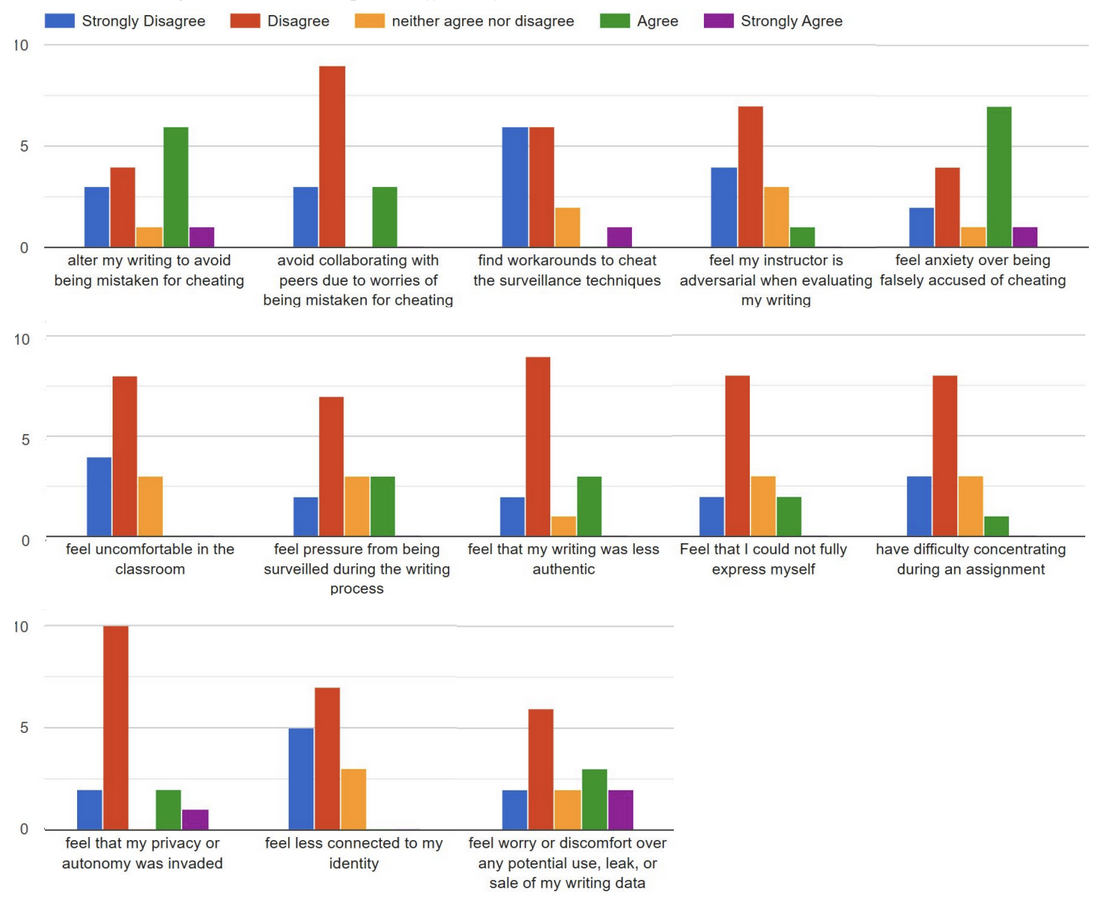
Note. Student ratings on how strongly they agree or disagree that proposed effects of academic surveillance fit their personal experiences.
Beyond the expected reactions from Han et al. (2023), students did not report feeling the effects of an adversarial relationship between themselves and their instructors using academic surveillance, as was theorized in Zwagerman (2008).
Though the majority of expected responses did not manifest among the sampled students, several scenarios arose where half, or more, of responding students reported a negative reaction. Many students (n=8) reported feeling anxiety over being falsely accused of cheating. This fear may inform why around half the students (n=7) reported altering their writing to fit surveillance models, with several elaborating on how they deliberately changed their writing styles to avoid sounding like AI—namely by avoiding the use of em-dashes. Several students (n=5) were also worried about their data being used, leaked, or sold to other parties by surveillance companies.
These last three scenarios were also the ones most frequently elaborated on in the follow-up question, with one student describing their anxiety: “When a professor called me in to discuss my exam, even when I knew I hadn't cheated. I wonder, 'did I accidentally cheat?' I've started to use AI checkers on my work before submitting it just to ease some of that anxiety, and the checkers do sometimes say a few sentences appear to be generated, so I either alter the sentence or hope that the professor would distrust the checker the same way I do.”
3.4 Students Justifications:
Student responses continued to differ from the expected trend with the vast majority of students (n=11) surprisingly expressing that current levels of academic surveillance were justified, as displayed in Figure 4. Though most believed current levels of academic surveillance was justified, surveyed students did show a preference for certain kinds of surveillance methods over others. Students talked positively about instructors who surveilled their classroom by changing the way assignments were administered, such as “things as simple as blue book exams” or “increased in-person writing and pre-setting the source list students can use.” On the other hand, many students spoke disfavorably about instructors using AI or plagiarism detectors such as Turnitin. For several students, their reasoning was the aforementioned anxiety stemming from the possibility of false accusations. For others, however, the preference against AI and plagiarism detectors came from their perceived ineffectiveness. As one student points out: “I think a base level of surveillance is okay so that entire works aren't written by AI … but it is a long and difficult process to accuse a student of AI-use, so I don't think many professors go through that process even if they suspect it.” This description is notable because the student is frustrated with AI detection not because it may cause negative psychological outcomes, but rather because it is ineffective at stopping other students from cheating. Thus the opposite—surveillance effectively catching other students—is inferred as a desirable outcome from the student perspective.
Figure 4
Student Beliefs on Justification of Academic Surveillance
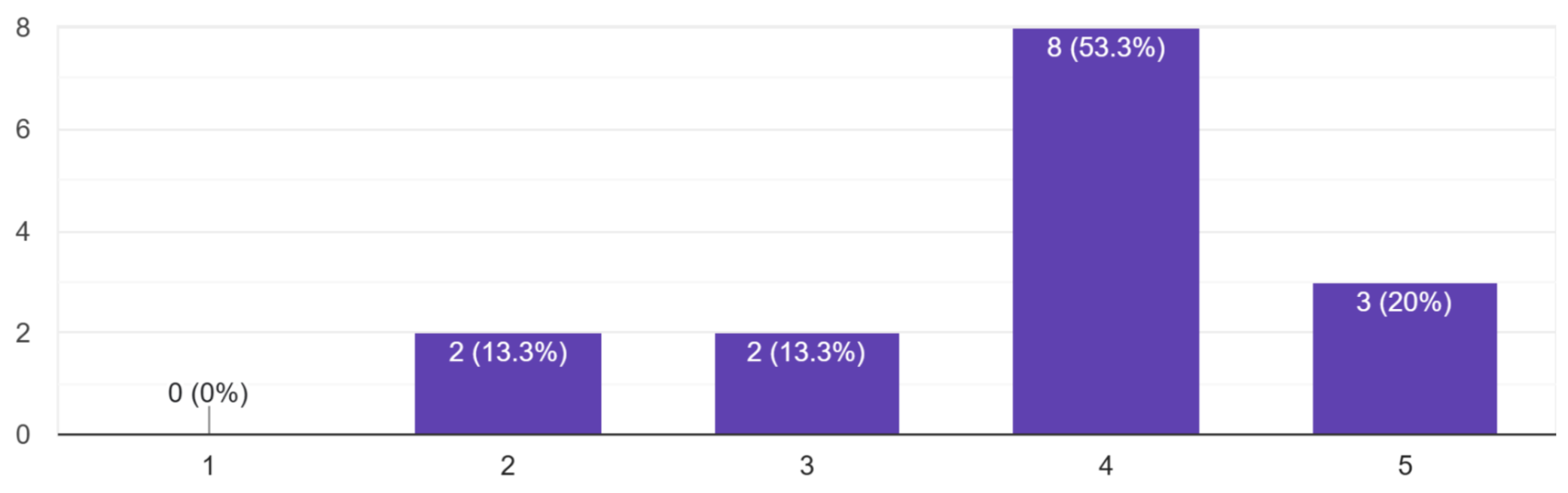
Note. Student self-reports on their general perspective on whether academic surveillance is justified, ranging from “Not at all justified” (1) to “Completely justified” (5).
Follow-up responses help to clarify why students showed such strong support for academic surveillance, with nearly all responses mentioning their peers’ increasing use of AI as their primary justification. These responses came both from students with no apparent qualms regarding surveillance. “I feel like to prevent the use of technologies and strategies that do not represent student knowledge of the material on writing assignments, some level of surveillance is acceptable, especially with things as simple as blue book exams.” Although students felt frustration regarding surveillance, they still saw it as necessary, “I do feel like some level of surveillance is necessary due to AI. However, it can feel irritating considering I have never cheated on a writing assignment; still, I do value it for keeping my fellow classmates honest.”
4 - Discussion
4.1 Preferred Surveillance Methods
Students showed a clear preference towards surveillance methods such as blue books compared to methods such as Turnitin. One way of generalizing this preference is that students prefer surveillance methods which augment the assignment, rather than retrospective methods which are employed after the writing phase. A simple “air of surveillance” in the classroom is acceptable to most students, functioning with little negative effect and in fact being appreciated by some for discouraging or preventing cheating. However, any method which attempts to look back at work and identify cheating—in the process running the risk of false positives—does negatively impact students while also failing to reassure them that they are protected from their peers’ cheating.
4.2 Adversarial Academics
Though students reported not feeling the effects of the adversarial student-instructor dynamic predicted by Zwagerman (2008), many student responses indicated a palpable adversarial peer-to-peer relationship. The othering tone present in many responses was particularly severe, with students valuing surveillance for “keeping my fellow classmates honest” and how some students simply “tend to be academically dishonest.” This “us versus them” mentality even leads students to willingly give up freedoms in order to target their peers. Despite the worry of false positives, one student argued that academic surveillance is justified because “students that are not academically dishonest don't have much in the way of ‘being caught cheating’ to worry about…they should have revision history or evidence that they did not cheat.” This student is so concerned with their peers cheating that they willingly accept being seen as guilty until proven innocent.
The reason for this adversarial relationship likely stems from the adversarial nature of many grading systems themselves. As one student noted, “I have a problem with classes that essentially make the grade ‘cheat by using AI or get a worse grade.’ Sometimes it feels like I’m competing with the entire internet for my grade instead of my peers.” In this case, the cheating of a student is not just personal—it directly harms their peers. For many of the students surveyed, the detriments of academic surveillance were preferable to the tangible harms caused by their peers' dishonesty.
4.3 Limitations
Although grounding this study in student experiences offered insight into the tangible effects of current surveillance practices, it also means the study was prone to more biases than comparable theoretical work. The sample taken was from mostly upper class students, the majority of which were part of the dedicated Writing Fellows Program. While a convenient population for surveying, these respondents may have been more inclined to favor academic surveillance due to their roles as pseudo-instructors. Anecdotally, conversations with peers in the Writing Fellows Program often conveyed a deep frustration with AI and students’ use of it, giving further plausibility for why these respondents may favor surveillance more positively than the average student.
Additionally, this study focused on students’ own perception of their work and cognition under academic surveillance. As the survey relied on self-reports, unconscious biases and unnoticed behavioral changes may not have been noted in the survey. This possibility is evidenced by the change in students’ self-reported awareness of academic surveillance: the stark increase in awareness by the end of the survey may imply that, prior to having a survey to prime them, many students may not notice academic surveillance as it occurs.
Future research may account for both of these issues. The primary method would be to recruit a larger, more diverse sample to ensure the study is generalizable to undergraduate students at large. An additional method would be to directly test student behaviors by comparing performance in controlled exams with or without the presence of surveillance, reducing potential unconscious bias from students self-reporting.
4.4 Conclusion and Implementation
Though small, this exploratory study indicates that the actual effects of surveillance on students are far more muted than much of the current literature predicts. Students most often disfavor retrospective approaches to surveillance such as Turnitin, so it is advisable for instructors to utilize other methods when possible. However, issues arising from adversarial peer-to-peer relationships are much harder to tackle. Peers’ cheating has a very strong effect on students, to the point that many are willing to sacrifice anxiety and discomfort in order to prevent it. To meaningfully tackle this dynamic, solutions cannot just target the obvious symptoms. To reduce peer-to-peer animosity—and hopefully cheating overall—a holistic look at the root causes of cheating must be taken into account. There may be an increasing culture of cheating among students, especially with increased AI use. However, that culture is not solely rooted in individual student behaviors; instead, it stems from the academic conditions students exist in. Therefore, those academic conditions must be the target of future change.
References
Canzonetta, J and Kannan, V. (2024). “Globalizing Plagiarism and Writing Assessment: A Case Study of Turnitin” In Considering Students, Teachers, and Writing Assessment: Volume 1, Technical and Political Contexts. https://doi.org/10.37514/PER-B.2024.2166.2.10
Fernandes, M. and McIntyre, M. (2025). “Drafting defensively, documenting authorship: An analysis of Draftback and Grammarly Authorship.” Computers and Composition Volume 76. https://doi.org/10.1016/j.compcom.2025.102926
Gegg-Harrison, W. & Quarterman, C. (2024). AI Detection's High False Positive Rates and the Psychological and Material Impacts on Students. In S. Mahmud (Ed.), Academic Integrity in the Age of Artificial Intelligence (pp. 199-219). IGI Global Scientific Publishing. https://doi.org/10.4018/979-8-3693-0240-8.ch011
Golding, J. M., Lippert, A., Neuschatz, J. S., Salomon, I., & Burke, K. (2024). Generative AI and College Students: Use and Perceptions. Teaching of Psychology, 52(3), 369-380. https://doi-org.ezproxy.library.wisc.edu/10.1177/00986283241280350
Han, Bingyi and Buchanan, George and Mckay, Dana (2023). Learning in the Panopticon: Examining the Potential Impacts of AI Monitoring on Students, Association for Computing Machinery, New York, NY, USA.
https://doi-org.ezproxy.library.wisc.edu/10.1145/3572921.3572937
Watkins, M. (2025, Mar 16), When Algorithms Watch You Write. Rhetorica. https://marcwatkins.substack.com/p/when-algorithms-watch-you-write
Mills, A. (2024, Nov 25) What is process tracking and how is it used to deter AI misuse? MLA-CCCC Joint Task Force on Writing and AI.
https://aiandwriting.hcommons.org/2024/11/25/what-is-process-tracking-and-how-is-it-used-to-deter-ai-misuse/
Vee, A. (2024, Feb 20). Student Data is the New Oil. Computation & Writing. https://annettevee.substack.com/p/when-student-data-is-the-new-oil
Williamson, Ben. (2019). Datafication of Education: A Critical Approach to Emerging Analytics Technologies and Practices. In Beetham H., Sharpe R., Rethinking Pedagogy for a Digital Age. (ch. 13). Routledge.
https://doi.org/10.4324/97813512528054urlappend=%3Futm_source%3Dresearchgate.net%26medium%3D
article-1
Zwagerman, S. (2008). The Scarlet P: Plagiarism, Panopticism, and the Rhetoric of Academic Integrity. College Composition and Communication, 59(4), 676–710.
http://www.jstor.org/stable/2045703