
The Refugee as Abolition: Commemorating the 50th Anniversary of the Fall of Saigon
-
The Refugee as Abolition: Commemorating the 50th Anniversary of the Fall of Saigon -
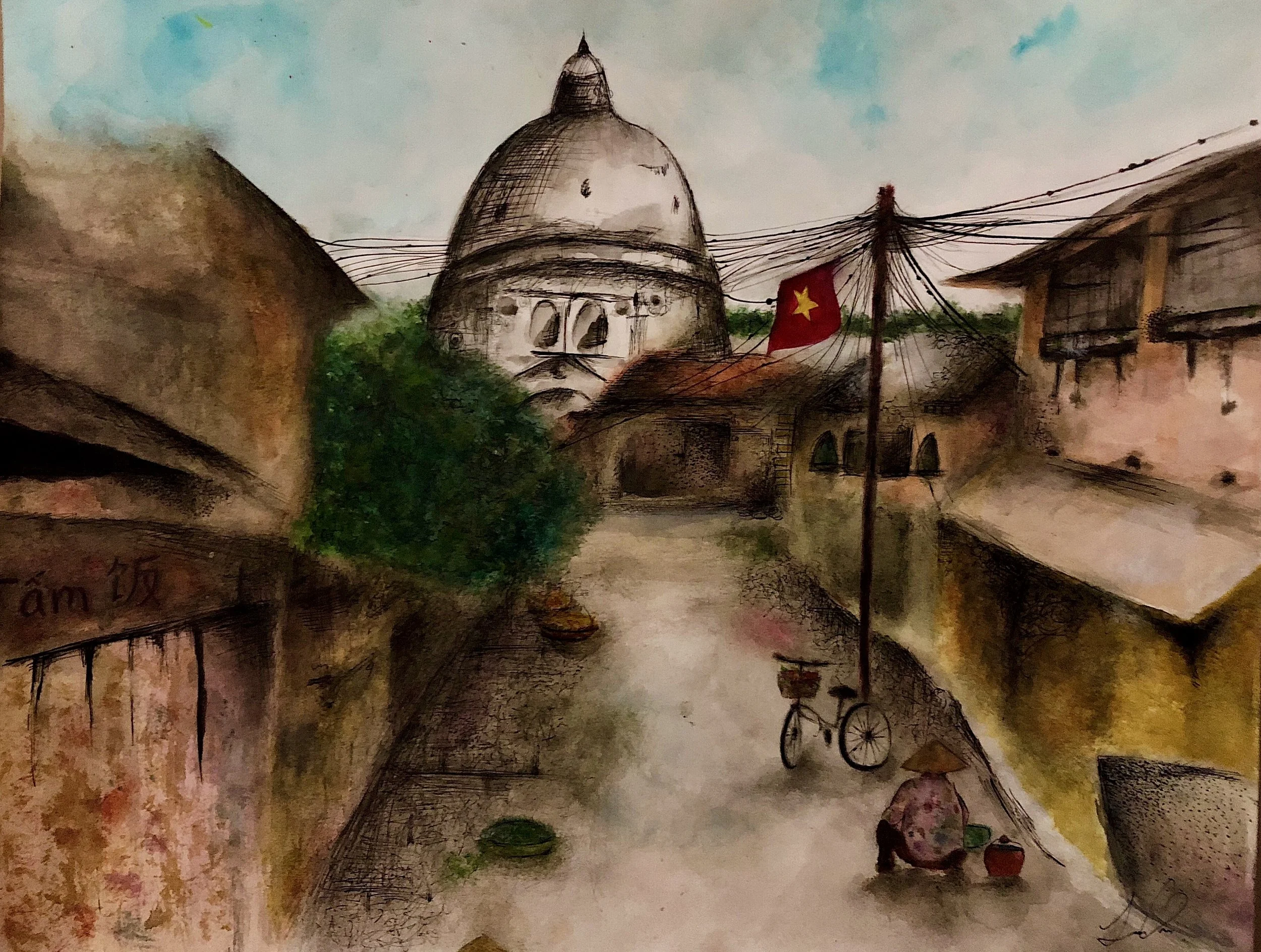
Đường - Toan Vu
Authors:
Anna Jyi, Lina Kang, Minji Kim, Chersa Lo, Heaven Moua, Tenzin Nyingpo, Cecelia Shervheim, Anyka Swanson, Mai See Thao, Emily Udomtanapon, Landis Varughese, Bai Xiong, Elliana Xiong, Michelle Yang, PaNhia Yang
April 30, 2025, marks the 50th anniversary of the Fall of Saigon and the withdrawal of United States troops from Southeast Asia. For most Americans, the 50th anniversary is a reminder of the two to three short paragraphs in U.S. history textbooks about America’s “failed war.” They learned that the U.S. lost the Vietnam War and “saved” Southeast Asian refugees under the guise of American benevolence. Absent in these lessons was the fact that this war was merely a proxy for the ongoing conflict between the U.S. and the Soviet Union. While decolonization efforts emerged in Southeast Asia against French colonial rule, civil war broke out across Vietnam, Laos, and Cambodia. The United States, seeking to contain the perceived threat of communism, militarily intervened in this region as well. Over 3 million Southeast Asians died from this conflict, and the impact remains fervent in our current moment.
For Southeast Asian refugees, this anniversary does not carry any more weight than the burdensome daily reminders of what they have inherited from the war. Celebrations of their refugee birthdays every year. Turning the same age their parents were when they first arrived in the U.S. The haunting absence of a sibling or relative, or the wounds of war on their grandparents' bodies and minds. Southeast Asian refugees living in the U.S. were not “saved,” as many Americans like to assume. 50 years in their place of “refuge” does not absolve the United States of its carcerality of refugees. Instead, it serves as a stark reminder of the refugee’s resilience and strife amidst ongoing harm.
As this anniversary approaches, we, the students of Asian American 540: Southeast Asian Memory and Trauma, write this introduction to commemorate the power of the refugee—a person who is at the margins of nation-states.The refugee teaches us that our trauma and losses are what connects us to each other. Viet Than Nguyen’s (Nguyen, 2016) work reminds us that war is only possible through the dehumanization of those on the margins and the abandonment of our capacity to be humane. War does not begin on the battlefields, but in memory, the practices that we embody every single day. Of whose stories are lauded and whose are censored. It is homegrown in the rhetoric of who we consider is human or not—who belongs and who are outsiders. War is born in our ideologies regarding racialized and gendered subjects, and which of those subjects are worthy of protection and fostering.
The refugee reminds us that all life is sacred and invaluable. So, we write this introduction to put forth a collective mourning about the 50th anniversary, but also the ongoing violence that perpetuates the possibilities of war. We tie our lives and histories to one another. May you also see yourself in our writings in the same ways we have throughout this course. And in recognizing yourself, may you hold a refugee abolitionist view of war and heart.
The refugee reminds us that all life is sacred and invaluable. So, we write this introduction to put forth a collective mourning about the 50th anniversary, but also the ongoing violence that perpetuates the possibilities of war. We tie our lives and histories to one another. May you also see yourself in our writings in the same ways we have throughout this course. And in recognizing yourself, may you hold a refugee abolitionist view of war and heart.
The Refugee as Abolition
The contemporary moment is saturated with discourses of the “other.” Violent nationalism, based on meritocracy and so-called “colorblindness,” excludes racialized minorities, including refugees and immigrants. In this introduction and the selected student writings, we put forth the social figure of the refugee as a form of abolition, one that illuminates the violence and limits of nation-states (Espiritu, 2014), while also deepening our relationship to the refugee through the illustration of collective mourning and healing.
“Existence is a form of resistance”
The refugee as abolition is a source of power that queers the institutions and stories of nation-states, of who belongs and of whose life is worth fostering and at whose expense. This social figure reminds us that existence is a form of resistance. Through the refugee’s melancholia, the refugee’s continual remembrance of war and its consequences, reminds us that traumatic events are not to be gotten over with but rather lived with and forever a part of us. Despite the totality of nation-states who shape and constrain their life and living, the refugee continues to construct futures for themselves and their descendants (Espiritu et al., 2022). It is from the refugees that we remind ourselves and others that even amidst the ongoing historical amnesia that our global leaders perpetuate in ignorance and oppression—we are still here. We are still breathing, alive, and full of potential to create a viable future for each other.
Silenced Histories and Collective Mourning
Poems, essays, and short stories told in this collection illuminate the violence of the Vietnam War and the wars spilled across Vietnam, Laos, and Cambodia. America has remained fascinated with the Vietnam War and American war veterans’ stories. However, in telling American war stories, Southeast Asian stories are often erased and silenced. The lack of Southeast Asian refugee stories replicates a form of trauma as described by Dorothy Allison that is rooted in impossibility; it’s “to see yourself never in the world. To feel yourself so unspeakable, forbidden, dangerous” (Allison, 2016). Leaving Southeast Asian refugee stories out of public conversations and national history only continues to marginalize and isolate these communities. Ignoring their experiences shows that society fails to address the lasting effects of war and displacement on them and their families. This systemic neglect not only denies the validity of their suffering, but also erodes the possibility of collective healing—not just for Southeast Asian refugees, but Americans haunted by the Vietnam War and other wars like it.
The refugee as abolition reminds us that in order to envision a better world where we can tell inclusive stories, we must mourn collectively. As an act for more inclusive forms of remembrance, our writings summon up silenced histories with intentionality. Dorothy Allison (2016) cautions the use of trauma narratives, and their potential to retraumatize readers, by doing our own work in constructing stories that are not filled with “bitterness.” This “work” that she alludes to involves directly challenging the horrors that haunt the afflicted, surrounding ourselves with those who share these traumas, and working towards healing with a renewed sense of self (Allison, 2016). Allison states that recognizing and honoring these stories goes beyond asking for justice. One must challenge the systems that keep silencing them. Without recognition, the trauma and violence of nation-states to implement war will go unnoticed, and future generations will continue to struggle with the effects of erasure and exclusion. This silence perpetuates a disconnection between historical truth and collective memory, thus making it easier for societies to repeat the same mistakes while those who carry the battle scars of war are left to mourn in obscurity.
Refugee Melancholia
Mourning is often seen as a linear progression to overcome experiences of loss by gradually letting go of the past. Whereas melancholia, the inability to get over what was lost, is pathologized (Freud, 1917). Refugees, in particular, are often encouraged to “move on” from their traumatic past as part of the assimilation process, leaving behind their histories in favor of adapting to their new place of refuge. However, humanities scholars’ reengagement with Freud’s melancholia offers a different perspective.
Melancholia is not pathological. Instead, it creates an open-ended relationship with history, where the past is presently alive with us and continuously influences how we live (Eng & Kazanjian, 2003). Rather than a process of resolution, melancholia involves a deeper, unresolved attachment to the loss that can become an integral part of one’s identity. We employ melancholia to highlight how trauma can become a site of active political confrontation with loss. Where the continual remembrance of systemic violence that informs one's trauma, such as in America’s war in Southeast Asia, can transform those persistent memories into a tool of resistance and political change.
“This perspective reshapes melancholia as more than sorrow—it is a space for transformative love”
The inability to move on due to the memories, the haunting of ghosts and those left behind, are remnants that serve as connections to what has been lost, and powerful symbols of resilience. Melancholia anchors refugees in their histories while confronting the forces that sought to erase their past. Grief does not need to be resolved or forgotten. Instead, the past continues to inform the present, demanding acknowledgment. It is through the fragments of what remains that we come to understand the full impact of what has been lost. This perspective reshapes melancholia as more than sorrow—it is a space for transformative love, where the lost and loved objects survive in the psychic realm (Eng & Han, 2018). Refugees, for example, may embody this form of melancholia due to their experience of displacement and racialization in their new place of “refuge” that teaches them to shed their identities. This racialization creates a layered grief that is tied to both loss of their homeland and systemic exclusion. This grief is multifaceted, encompassing the physical and emotional loss of home, the continuation of cultural erasure, and the marginalization they face as racialized subjects in their host countries (Eng & Han, 2018). It creates racial melancholia for refugees, where they experience loss and alienation rooted in collective histories of war, migration, and imperialism. Through this lens, the refugee experience highlights how grief and resilience are deeply interconnected, shaping both individual identities and broader communal realities.
Rather than fading with time, these hauntings of loss and trauma remain present due to the cyclical nature of history and the lingering consequences of war (Gordon, 2008). This enduring presence of loss, or “ghost,” challenges the notion that the past can be easily forgotten, instead highlighting how unresolved histories continue to shape the present. These “ghosts” are not merely metaphors but tangible manifestations of social injustices that refuse to be forgotten (Gordon, 2008). They emphasize the enduring impact of trauma, the impossibility of complete closure, and the need for acknowledgment and justice. As Gordon writes, “[t]he ghost is simply not a dead or a missing person, but a social figure, and investigating it can lead to that dense site of history and subjectivity [that] make social life” (8). By refusing to “get over” the loss and pain of wars, refugees, and other individuals who bear witness to trauma, these “ghosts” act as living reminders of systems of power and violence perpetuated onto psyches and bodies worldwide. Far from being a curse or burden, melancholia is a tool that allows for the visibility of social injustices. This visibility highlights the importance of bearing witness. As a result, we acknowledge trauma and trace the scars that provide narratives, fostering healing within the community (Stevens, 2016).
Refugee as Abolition is about Healing
Healing is a messy and dynamic process that demands us to grapple with the pain and harm that we’ve experienced in order to cultivate a sense of resilience in the face of chaos. It is necessary to sit with discomfort such as Allison's theory of “razor squatting,” the concept of hovering over the discomfort, anger, and frustration that accompanies trauma, while you are actively trying to mend your wounds (Allison, 2016, p. 249).
Healing is a journey that requires us to commit to bettering ourselves by confronting the horrors that trauma presents, and still choosing to love ourselves in the midst of it (Allison, 2016). Upon committing to this lifelong adventure, we are able to create an honest narrative—one that is personal, real, and a product of the love we’ve forged for ourselves as well as our communities. Healing enables us to preserve the loved objects we’ve been told to shed or get over (Eng & Han, 2018). As we read through these narratives, we are constantly reminded that healing is an ongoing, dynamic process. Writing, for the authors we’ve read from, is an act of healing—a mode of resistance—to the systems, those in power, and institutions that perpetuate and exacerbate trauma onto marginalized communities.
Abolition as Refugee for the Contemporary Moment
Our collective writing holds that trauma does not exist within people as a pathology, rather it is structured and informed by social, cultural, and political conditions. We draw on refugee trauma not as a thing in itself, but as an intersection that offers up powerful epistemological critiques of the world, and a source of connection and power. People may isolate themselves but there is importance of finding and creating community that can be healing, especially in times of traumatic events. It is important to remain cautious about how communities can create boundaries on who belongs or doesn’t (Stevens, 2016). The refugee—a liminal figure that haunts empires—sits in the inbetweenness of communities and nations. We lean on the ways the refugee as abolition is unfolding, coming together, and undoing as a potential to actualize a more livable and better world.
Works Cited
Eng, D. L., & Han, S. (2018). Racial Melancholia, Racial Dissociation. Duke University Press.
Nguyen, V. T. (2016). Nothing Ever Dies: Vietnam and the Memory of War. Harvard University Press.