
Maintaining Hope
Endurance Pre-Release Feature
˚⟡˖ ࣪
Endurance Pre-Release Feature ˚⟡˖ ࣪
Throughout the first half of this semester, we focused on the topic of hope in our study group. From Huey P. Newton’s Revolutionary Suicide to Mariame Kaba’s “Hope is a discipline” interview, each week we focused on a different tool that has been historically used to maintain hope. Hope is fundamentally intertwined with endurance—it is the mental fortitude that is needed in order to continue fighting towards liberation. To give you a taste of what the Endurance issue is all about, we asked the MJLC staff to write about how they maintain hope. Perhaps at least one of our perspectives will stick, and you will be able to bring these ideas into your daily community organizing practices.
You, me, and all the little things in between
In all honesty, hope is hard to keep hold of, especially in today’s world. In this state of globalization and widespread technology, we are constantly inundated with information, with much of it being disastrous and disheartening. In times of turbulence, we must hold on to what is stable to keep us afloat.
My life is buoyed by my family and friends, as cliché as it may be. My mind’s murky waters are cleaned and cleared through quality time with my favorite people who fill my life with love, care, and community. Together, we commiserate our sorrows, spill our guts, and dream of better times.
Navigating through life is difficult, and loneliness can easily turn into hopelessness. When it is hard to see my own future clearly, I can always fall back on thinking of the lives of my loved ones, finding things to look forward to, both big and small.
Picking out gifts for Christmas. Helping my sister plan her wedding. Seeing my cats again.
Hope is a feeling, desire, and a staple. It is somehow both fleeting and steadfast. While I believe hope is continuous, it is not steady; personally, I have my own cycles of mountains and valleys. But what keeps the equilibrium in my world are the people whom I love, the ones who I always hold on to hope for.
Shu Lan Schaut
The smaller picture
I usually try to keep an optimistic outlook, but when you’re surrounded by today’s state of political, social, and environmental affairs, among others, it can be hard to maintain hope. Since I was young, I’ve found myself spiraling down the ideological hole of existential pessimism. Looking at the big picture didn’t necessarily help, either, since it led to the philosophical question of whether anything truly matters if, ultimately, we are simply specks living on a “floating rock” in space.
What has helped me is to look at the smaller picture. Sure, in the grand scheme of things, it may not seem that our actions result in a life-altering impact. However, our daily actions, casual relationships, or shifts in perspective impact everything around us. Even the smallest change can mean the whole world to someone. So, if our time on the floating rock is limited, why not make it the best we can? With this mindset, I maintain hope that our seemingly insignificant presence can create a rebound effect of positivity—because what do we have to lose from trying?
Sofia Borden
Seeing the cycle
For some, maintaining hope is a constant state of being—a constant practice of mindset, action, and reaction. For me, devoting myself to a constant practice of mindfulness like this is draining and desensitizing. Instead, when I’m drowning in my obligations, I find small moments to reflect and look on my trajectory: will I resurface? And then, will I drown again? There is a macro-level term for this in social sciences called the Social Cycle Theory, which explains periods of economic, social, political, and cultural decline or expansion as non-linear paths, pulsing like the tide. My life is much less complex than the global economy, but when I feel overwhelmed, I look forward to the upward path of my revolution. When I feel like my country and my government are being irreversibly dismantled by an oligarchy, I remember that I’m only in one part of history, and the more my country crumbles under the weight of greed, the more of it we can replace with care. I look forward to that regrowth, and I will be a part of it. Happy or sad, drowning or afloat, nothing lasts. I appreciate the good moments for being good and the bad moments for being temporary.
Max Borgerding
Ambivalence
I enjoy assuming many different faces when it comes to maintaining hope. When I’m feeling a bit more pessimistic, maybe I’ll lean towards the absurd with Camus, or even to the cosmos when I’m feeling larger than life with Carl Sagan’s “Pale Blue Dot.” However, I do think it’s nice to have one core belief to fall back on, no matter what. As of late, I have found solace in Alok Vaid-Menon’s writing on hope.
In a piece about chronic pain, they note that “hope is the cultivation of ambivalence, a surrender to the infinite unknowability of the universe.” As someone who finds a lot of meaning in the idea of the unknown, I love coming back to this line of thinking. Vaid-Menon expands on this idea by highlighting that "optimism and pessimism both require a prescription of what will be.” In other words, anything could happen, so why can’t we build the world that we want to live in together?
I also like to remind myself that hopelessness is a privilege, and that everyone’s liberation is tied together. My own inaction affects others’ ability to be free, and reflects my own privilege within a country built upon white supremacy. Lastly, when all else fails, I know that I will find the answers in community. All these factors together help me to continue to fight towards liberation in my everyday life, and lift others up to do the same.
Quinn Henneger
Memento Mori
In English: “remember you will die.” To some, this seems like a looming threat—a reminder that you can lose the life you have built for yourself at any given moment. To me, though, this is a phrase of hope. Maybe the state of the world will only get worse, and maybe none of us will ever be freed. If that is the case, we will be freed in death. None of us will be prisoners of the state forever, and if we know liberation only in death, so be it. I would rather know liberation as a corpse than never know it at all. Death is not something to fear; it can provide a comfort that life may be unable to provide. Neither I nor the Stoic philosophers who originated this mantra believe we should spend our lives waiting to die. Rather, we should embrace our current state of being to the fullest of our abilities and keep fighting for our freedom in life. If we don’t know this freedom here, though, there is hope: we will get to know it eventually.
Mar McKenna
Spiteful creation
Life recently seems to be marked by turns for the worse—whether political, social, or environmental—on a scale so grand it is demoralizing and demotivating. But I’ve found that the best way to fight heedless destruction is to simply create. For me, this looks like making art in the form of mini zines reacting to issues I am angry or upset about. The folds of the paper and the simplicity of the black pen marks are a swift interruption to the mundanity of both a white page and the drudgery of hopelessness. It is not only a reflective practice, but an interactive one, as well. Community zine-dumps and collaboration with other artists is a great way to remember that you aren’t alone in the pursuit of a positive worldly contribution. If you instead gravitate towards music as a form of art, the same thing goes. Song-writing, jamming, and musical ensembles are acts of creation, too. Even if you aren’t confident in your artistic, musical, or otherwise creative prowess, creative spaces are usually some of the most supportive and encouraging communities for novices.
We enjoy relative privilege and abundance, and our lifestyles are complicit in exploitative and destructive processes. You might as well use those resources to make something that exists outside of yourself. Even if it feels insignificant, any and all creative acts supersede the individual and contribute to a collective offset of destruction.
Lydia Crabbe
The way upward
Well, this is it. My last year in the brief normalcy known as undergrad. As the time cascades away, I find myself frequently reflecting on all that my college experience has offered me. One feature that I commonly find in my reminiscing is the overcoming of challenges of all sorts, unpredictable in their nature and always appearing when least expected. Whether it’s hair-pulling assignments, sleep-deprived lectures, or the onslaught of world politics, I’ve observed one truism: negativity is a constant stream, but an illusory one. I always have the option to flip the narrative; how can I best enjoy what I’m doing, even when the current moment is dire? There are a few options that I’ve found to help me. For burn-out, I reconceptualize monotony for autonomy. Boring tasks give us the time to grow beyond the mold, and become better for it. When feeling hopeless, I find folks to endure with. It makes struggle manageable, and brings you genuinely closer to those around you. Finally, on days when I just feel lost, I like to stay lost. Take time to find footing without rushing to the nearest foothold. The way upward is not neat; being hopeful requires effort, patience, and immense practice. Hope is a discipline, much like any field of study, and I work towards hopefulness not as a final destination—but as the way up.
Jonathan Tostrud
Pushing the boulder
Hope is often an intrinsically positive thing associated with an outlook on life that strives to believe that good things will happen. But it’s hard to maintain this positive outlook when the inevitable waves of life crash onto a peaceful shore, drowning the sand in all-consuming negativity. That’s why, to maintain hope, you have to imbue it into the normal. The thought process follows as such: I can do something. Because I can do that thing, I give that action meaning through my ability. This meaning gives me motivation, which provides hope. This is a hope that lets you look forward to “doing”—to the now—rather than the benefits of a future that will forever be murky and difficult to predict. I focus on what I can control in order to prevent my mood from being at the whims of the world. That’s how I maintain my hope: one action, one step, one day at a time.
David Rhee
“Hope” is the thing with feathers
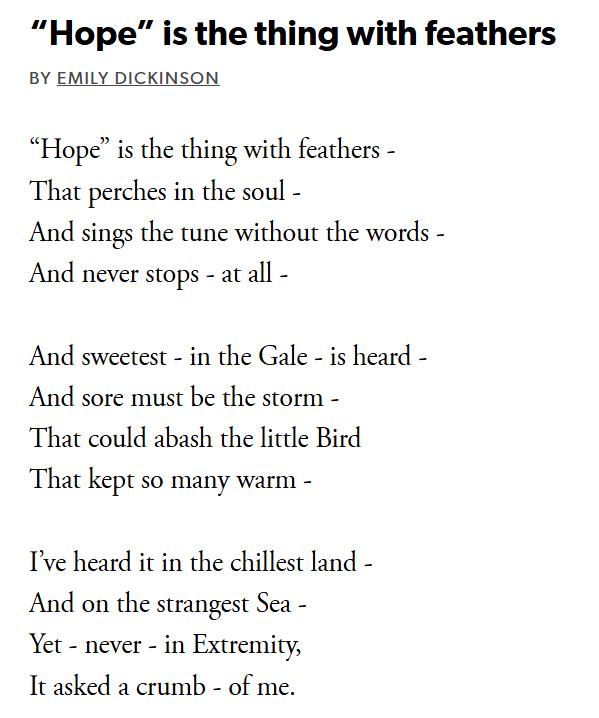
Hope is an uncomfortable feeling for me to confront because I lived without it for so long; there’s still a disquietude that accompanies its presence for me. No matter how hard I’ve been trying, I haven’t quite been able to translate what hope means to me into words, because my journey to becoming hopeful was such a long and complicated one.
Then I recalled a favorite poem of mine, “‘Hope’ is the thing with feathers” by Emily Dickinson. Dickinson paints hope as a generous songbird perched in the human soul, who continues singing its tune despite the adversity it encounters. The poem alone is enough to inspire hope in even the coldest of hearts, but it represents something more to me.
Birds give me hope. No, I am not joking.
Anyone who knows me knows that I like birds, but my love for these little guys is more than just an arbitrary fascination. In my darkest hours of hopelessness, I often retreated into nature—no goals, no time limit, nobody. I’ll never forget the first time I felt my perspective on hope shift: in the cold air of a Wisconsin late-winter-early-spring morning, the dawn broke and a red-winged blackbird cried out in the distance—the first birdsong of the year.
Birds migrate thousands of miles in search of a better life, guided only by memory and instinct. They lift themselves from the ground, trusting in the gift of flight in spite of gravity. They sing their songs not to remark on the beauty of the world, but because morning and spring are on their way.
Birds show me that I can find direction in uncertainty, rise above the weight of the world, and trust that I will find a place where the air is warmer—loving, even. They remind me that, no matter how small I feel, I am an agent of my own change; that I, too, am capable of pushing myself beyond my comforts in pursuit of a new beginning. That I can withstand the weight of the world. That something more is in store for me.
Hannah Herbst